
A link is a seller, a variant and a promise, and only one of the three travels
Pasting an address looks like naming a product. It is closer to signing for one shop, one colour and one size, and inheriting a set of terms that were written for somebody living in China.
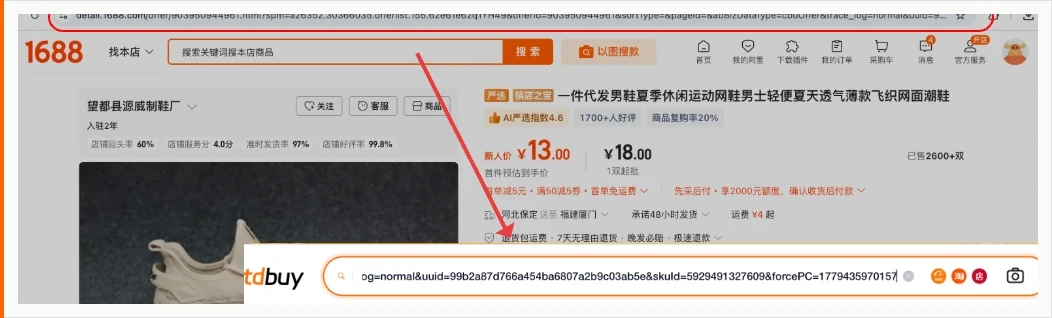
Everything on this page can be read off the screens below. Nothing on it is a price, a rate or a delivery promise.
The address
The address is not the product, and the page around it is not yours
A link copied out of a marketplace listing is a long string with parameters on the end of it, and at least one of them usually identifies a variant. That is why the colour and the size can be settled before you have chosen either: the address you were sent already contains somebody else's choice.
The page the address points at belongs to a shop, and that shop publishes its own record: how long it has traded on the platform, its service rating, the share of orders it dispatches on time, the share of buyers who rate it well. None of that reaches you through a list. It is sitting on the seller page, which is the argument for opening the link before submitting it.
The wholesale side of the Chinese market is where most of these listings live, and it is written for people buying by the box. Tier prices, minimum quantities and a delivery fee quoted between two Chinese provinces are normal there. They are only confusing once a link has been forwarded into a conversation that never mentioned any of it.
Operator reference · dated capture
Two screens
The same shoe, described twice, and only the second one is binding
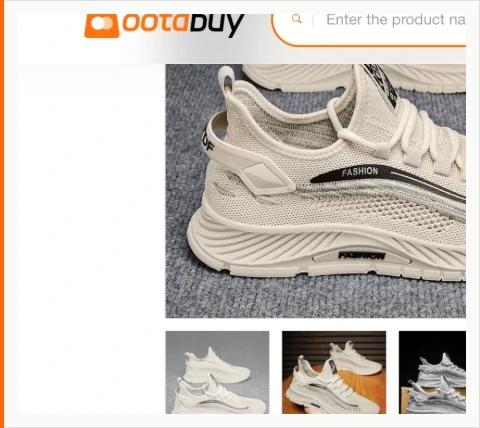
Between choosing and paying, the operator shows you the item in two completely different registers. The first is a gallery: large photographs, supplied by the seller, arranged to be looked at. The second is a confirmation row: a line of text and two words of specification, arranged to be agreed to.
The gap between them is where returns come from. A photograph cannot be wrong about a size. A line reading a colour and a number can be, and it is the line that the buyer will act on.
What you look at
The operator's own product view, built from the seller's photographs.
Operator reference · dated capture
What you agree to
The confirmation panel, immediately before the order is placed.
Operator reference · dated capture
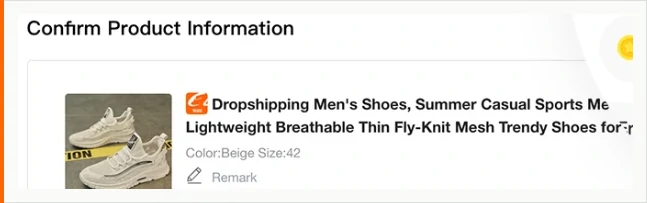
The Remark field on the right is the only place in this flow where you can say something in your own words. It is worth using for the one thing the variant code cannot express.
Six promises on the seller page, and what is left of each one
None of the entries below is broken by the operator. They simply were not written for a parcel that leaves the country. A marketplace promise is an agreement between a Chinese seller and a Chinese buyer, and once an agent stands between you and the seller, you are not the Chinese buyer.
| What the seller page says | Who that binds | What is left after an agent joins |
|---|---|---|
| A waiver on delivery for a first order | The seller, for a delivery inside China | It applies to the leg that ends at the warehouse, and to nothing after it |
| Dispatch inside a fixed number of hours | The seller, once the seller has been paid | The clock starts when the buyer pays, which is after your first payment |
| A no-reason return window | The seller, under the marketplace rules | Its clock starts at the warehouse door, because that is the delivery address |
| A delivery fee quoted province to province | The seller | Replaced outright by two legs that are priced separately |
| A newcomer price beside a list price | The seller's own promotion | It follows the account that places the order, and that account is not yours |
| A minimum order quantity | The seller | Unchanged. Nobody in the chain can order below it on your behalf |
The third column is this site reasoning from the delivery address, not a rule the operator publishes. The operator publishes its own, separate return window, and that one is on the page about undoing an order.
What people ask once they have read the seller page properly
Judging whether the seller was worth the link in the first place is a separate page. What happens to the item after it is bought is the warehouse.
Does the link decide the size and colour for me?
Usually yes, and that is the part people miss. The address copied out of a seller page often carries a variant identifier, so pasting it selects a specific colour and size before you have looked at either. Read the confirmation screen, not the photograph.
The seller page says free shipping. Why am I paying for shipping twice?
Because the seller is quoting a Chinese domestic delivery, from its province to another province. That leg ends at the warehouse. The leg that crosses a border is a different service, sold to you later by the operator, and it is the second of the two payments.
Is a wholesale listing safe to order a single item from?
It can be, but read the minimum. Listings on the wholesale side of the Chinese market are written for buyers ordering by the dozen, and the price you are shown may be a tier price rather than a single-unit price. If the minimum is higher than one, one is not what you will get.