
What leaves China is settled by a list, a scale and somebody you will never meet
Two of those three are published and can be read in advance. The third is a customs officer working from a spot check, and the operator is unusually direct about where that leaves you.
No page on this site quotes a shipping rate. Rates move weekly, and a stale rate is worse than no rate. What is quoted here is the wording of the rules and the date it was read.
Outbound
Two labels on a drawing, and the moment between them that sets the bill
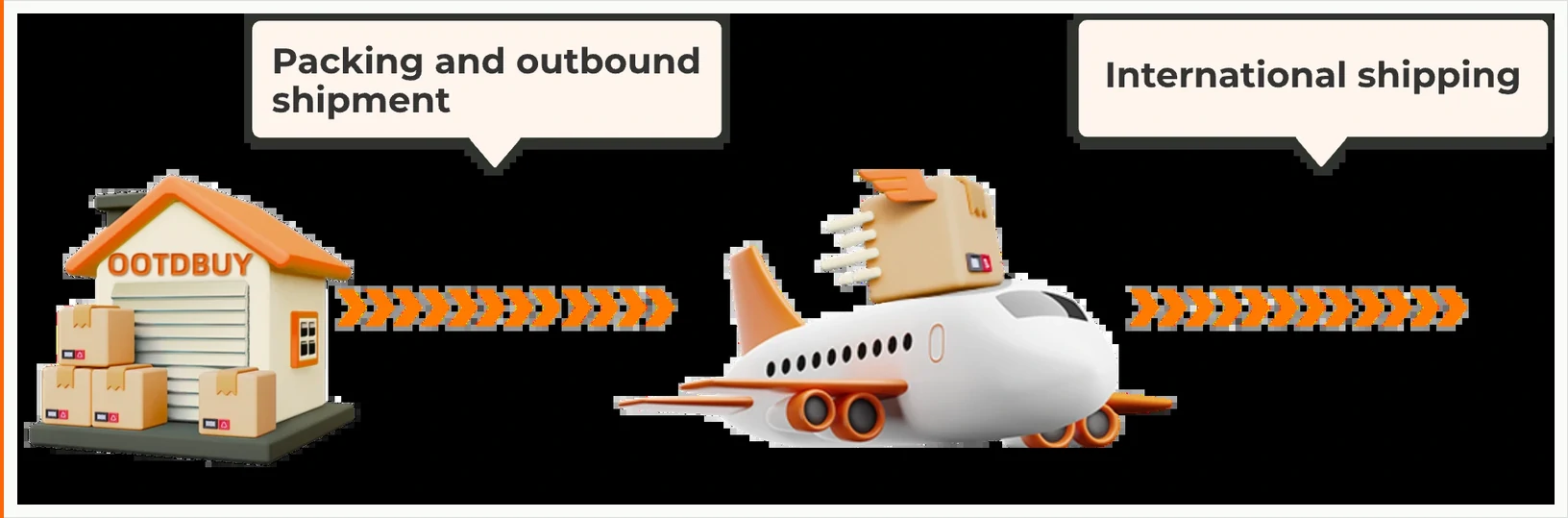
The operator splits the second half of the journey into packing and outbound shipment, then international shipping. The picture is simple enough to be worth nothing on its own. The gap between the two labels is where everything happens.
In that gap the parcel is assembled, measured and weighed, and a carrier approves a figure. Before it, every number you have seen is an estimate built from estimates. After it, there is a bill. The operator does not hide this, and its own wording is the clearest thing on the subject: the final cost follows the volume and weight the carrier approves.
This is also the last point at which the contents can change. Once the parcel exists, adding the thing you forgot means starting a second one, with its own weight, its own minimum and its own journey.
Guide outline
- 01WarehousePack the selected goods
- 02International shippingMove the parcel to the destination
View the operator’s illustrated reference
Operator reference · dated capture
What will not fly, grouped by the reason rather than by the alphabet
The operator publishes its restricted list as one long run of items, and reading it that way tells you almost nothing. Grouped by why each thing is on it, the logic appears, and so do the entries nobody expects. Most people can guess the lighters. Very few guess cheese, crabs and seeds.
The grouping below is this site's. Every item named in the middle column is the operator's own word for it, carried across unchanged.
| The group | What the operator names in it | What puts it there |
|---|---|---|
| Refused outright | Tobacco, alcohol and contraband | Stated on its own line, ahead of the list, with no qualifier attached |
| Edges of every description | Kitchen knives, letter and paper knives, gardening saws and scissors, seam rippers, putty knives, end mills, gravers, bamboo and wooden swords | Air cargo rules, which are not interested in what the edge is for |
| Things shaped like edges | Knife cards and universal knife cards, ice skates, other outdoor cutting tools | A card with a blade in it is still a blade at the scanner |
| Food that travels badly | Pure fruit and vegetable juice, cheese, crabs, seeds | Liquids, perishables and anything an agricultural inspector opens |
| Things that interfere | Lighters, magnetic components | Standard restrictions on what may ride in an aircraft hold |
| Rights rather than physics | Any product which does not possess intellectual rights | Quoted rather than summarised, because the wording is not this site |
| Limited, not banned | Medicine, liquids, creams, powder, cosmetics | Restricted by Chinese export rules. The operator says to ask before buying |
The operator writes that restricted items include but are not limited to the ones it names, and the published run repeats the Swiss army knife twice, so treat the list as the shape of the rule rather than its outer edge. The notice in full.
There is a calculator, and there is a good reason its answer is not the bill
A shipping estimator sits on the operator's own front page and takes the three inputs you would expect: what it weighs, how it is going, and where it is going to. It is useful, and the use it is good for is not the one people reach for.
Comparing routes against each other is what it does well. Two methods quoted for the same parcel will keep their order once the real weight arrives, because the same weight goes into both. Predicting the number you will actually pay is what it does badly, because every input you gave it was a guess about an object nobody has weighed.
There is a second filter it cannot show you. The operator says not all logistics routes can carry every product, so some of the options the calculator prices may simply not be offered once the parcel contains something from the list above.
Operator reference · dated capture
Liability
Where responsibility moves, written plainly enough to plan around
The operator guarantees the condition of goods up to the moment they are shipped. What it says about the stretch after that is direct, and it is the single most useful sentence on the subject anywhere on the site.
If the items are damaged during the delivery process and are judged to be fragile by the logistics provider, the resulting loss shall be borne by the user
Glass and ceramics are the operator's own examples, and its parcel notice sharpens the point further: for fragile and vulnerable goods a claim can cover loss but not damage, and paying for strengthened packaging does not change that. Read together, the two notices say something worth acting on. Reinforced packing lowers the chance of breakage. It does not create a right to be paid when breakage happens anyway.
The same notice sets the clock at the far end. Check the outside of the parcel before signing, and if it is visibly damaged, open it in front of the courier and either note the damage or refuse it. If it has already been signed for, the operator asks for the original packaging and photographic evidence within two working days, and for any problem at all to reach customer service within seventy-two hours. What happens after that window.
Operator reference · dated capture
The deposit, the scale, and the two directions the money can move
The second payment is not a price. It is a deposit against a price that does not exist yet, and the operator explains the mechanism on the screen where you pay it.
You pay against an estimate
The deposit is worked out from an estimated weight, the method you picked and the area you are sending to. The operator describes all three that way. None of them is final at the point you pay.
The warehouse packs, then weighs
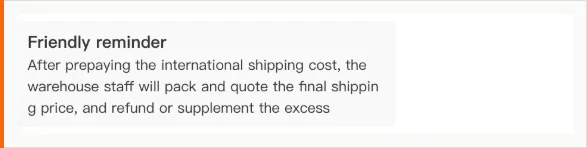
The operator says staff pack the parcel and quote the final shipping price afterwards, and that the final cost follows the volume and weight the carrier approves. Packing comes first because packing is what decides the volume.
The difference settles in both directions
Lower than the deposit and the excess goes back to your account. Higher and a second payment is required before the parcel moves. The operator states both halves in the same sentence.
Which is why an estimate is not a budget
A deposit that can be topped up has no ceiling in it. Budget against the route rather than against the number a calculator returned. What the settlement looks like when it lands.
The three questions that come up once a parcel is ready to go
What the warehouse did before this point is the previous page. What can still be reversed, and when it stops being possible, is the ladder.
Why can I not see the courier I used last time?
Because the menu is filtered by what is in the parcel. The operator says some products are subject to mailing restrictions and that not every route can carry them, so changing the contents changes the list of routes. If a familiar option has vanished, submitting a smaller selection is the quickest way to find out which item removed it.
Who pays if customs takes it?
You do, on the terms the operator publishes. Its parcel notice says it checks material and category but cannot identify what is genuine, fake or an imitation brand, and that a parcel confiscated for those reasons is your responsibility. The same notice puts customs fees generated by destruction on the receiver.
Is insurance worth buying?
That is a judgement rather than a fact, and it turns on a rule instead of a price. For goods a carrier classes as fragile, the operator says a claim can be made for loss but not for damage. Insuring a ceramic against breaking and insuring it against disappearing are not the same product.