
The help desk, the jargon and the exchange rate all answer to somebody else
Three things decide how a problem goes: which column of the help centre it belongs to, whether the words being used mean the same to both sides, and which day the money was converted on.
When you need help, it has to come from the operator. This site cannot look anything up in your account and has no way to contact it on your behalf. What it can do is tell you which door to knock on and what time that door opens.
The desk
Six columns at the foot of the operator site, and what their lengths give away
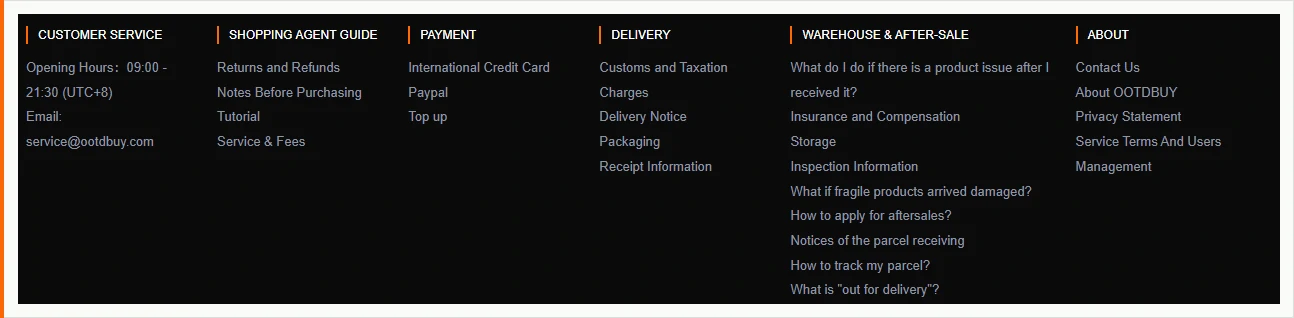
The help centre is laid out as six columns, and the quickest read of it is not the contents of any one of them. It is how long they are. Payment has three entries. Delivery has five. Warehouse and after-sale has nine.
Help centres grow where the questions are, so a column three times the length of its neighbour is telling you where things go wrong most often. Reading the longest one first is a reasonable way to spend twenty minutes before a first order rather than after a bad one.
The heading marked Customer Service is the one to note down. It carries the email address and the opening hours, and the hours come with a timezone: 09:00 to 21:30 on a UTC plus eight clock, as published in the operator's own guide and read on 2026-09-23. That window is the middle of the night across most of Europe and the Americas, which explains a great deal of the silence people report.
Operator reference · dated capture
Nine pieces of shorthand, and which of them anybody official uses
Most of the confusion in this hobby is vocabulary rather than process. Two people use the same three letters to mean different things, agree with each other, and find out a fortnight later that they had not.
The third column is the one worth reading. It separates the words that appear on the operator's own screens from the words that only ever existed in chats.
| Short form | What it stands for | Where you actually meet it |
|---|---|---|
| QC | Quality check, meaning the photographs taken once the warehouse opens a parcel | Folded into a reminder panel under the item row. Nothing announces them |
| GL | Green light, community shorthand for approving what those photographs show | Chats and lists. It is not a button and it commits nobody to anything |
| RL | Red light, the same shorthand in reverse | The same place. In practice it means you go and raise the problem yourself |
| W2C | Where to cop, the question asked about something seen in a photograph | The question a list of links exists to answer |
| Batch | A set of items sent out of the warehouse together as one parcel | The submission screen, where the packaging switches and the route menu are |
| Stocked in | The status meaning the warehouse has received an item and shelved it | The status column, and the moment the return window starts counting |
| Line or route | A shipping method rather than a named courier | The menu on the submission screen, filtered by what the parcel contains |
| Haul | Everything that arrived in one batch, usually photographed together | Social posts. It is a result rather than a stage of anything |
| Spreadsheet | A published list of source links arranged by category | A site like this one. It holds no goods and takes no payment |
Green light and red light appear nowhere in the operator's notices, and nothing at the warehouse is waiting for one. Treating them as a service is how people end up waiting out a return window they could have used. What that window is.
Currency
What currency the number is in, and the three places it can change
Source listings are priced in yuan, and the operator's own settlement screens are in yuan as well. The figure that lands on your statement is not necessarily either of them, because as many as three conversions can sit in between.
The first is from the listing to whatever display currency you selected on the site. The second is from that display currency to the one your payment method actually settles in, which is not a free choice: the checkout restricts it by method and by destination, and one of its two groups is limited to a single country and a fixed set of currencies. The third is your own card issuer converting again if those two still differ. Each conversion happens at the rate in force at the moment it happens, not the moment you looked at the screen.
Two practical consequences follow, and they cost people real money. A total you screenshotted yesterday and a charge you were billed today were converted at two different rates, so the difference is not a hidden fee and there is nothing to dispute. And because there are two payments with a warehouse between them, sometimes weeks apart, the freight settlement converts on its own day. A currency that moved in the gap shows up there, in a figure that has nothing to do with shipping.
No page on this site quotes a rate. A rate printed into a guide is wrong by the week after it was written, and there is no need for one, because the operator prices its own screens and the card statement is the only record that settles an argument. What is worth planning around is the mechanism: three conversions, three moments, none of them the moment you decided to buy.
The five that arrive most often, answered from the published rules
These are the five most frequently asked of this site, and not one of them is answered here by opinion. Every answer is drawn from a dated operator notice, and the pages those notices sit behind are linked from each one. Where this site is reasoning rather than quoting, it says so in the sentence.
Nobody has replied. How long should I be waiting?
Check the clock before you check the queue. The operator publishes its hours as 09:00 to 21:30 on a UTC+8 clock, which runs from roughly midnight to midday across western Europe and overnight for most of the Americas. A message sent in your evening arrives before the desk opens, so the first silence is usually a timezone rather than a problem.
Where do I put a complaint so that it counts?
In writing, to the published address, with the order number and the date in the body of it. Several of the windows on this site are counted in days and one of them in hours, and a written message with a timestamp is the only thing that survives a later disagreement about when you first asked. Which windows those are.
The photographs looked fine and the item is still wrong. How?
Because the check has a published scope and it is narrower than the word suggests. The operator states that colour difference, size error and usage effect fall outside it. Photographs record the condition something arrived in, which is not the same as whether it suits you. What inspection does and does not cover.
Is there a telephone number anywhere?
Not a published one. What is published is an email address, opening hours with a timezone attached, and a named company with a registration number and a registered address. That is a smaller set than a phone line and a more checkable one. Who is behind it.
None of the above. Which page has my actual question?
If it is about what a seller promised, what a link carries. If it is about the shelf, the clocks or the photographs, the warehouse. If it is about what can fly and what the quote really is, shipping. If something has already gone wrong, the ladder.