
Goods do not travel to you, they travel to a shelf, and the shelf runs on two clocks
The warehouse looks like the part where nothing happens. It is the part where the most decisions get made, and where several of them quietly stop being reversible.
Every duration and every rule below is quoted from a dated operator notice and linked to it. Where this site draws a conclusion of its own, it says so in the same sentence.
Three marketplaces, one buyer and an address that was never yours
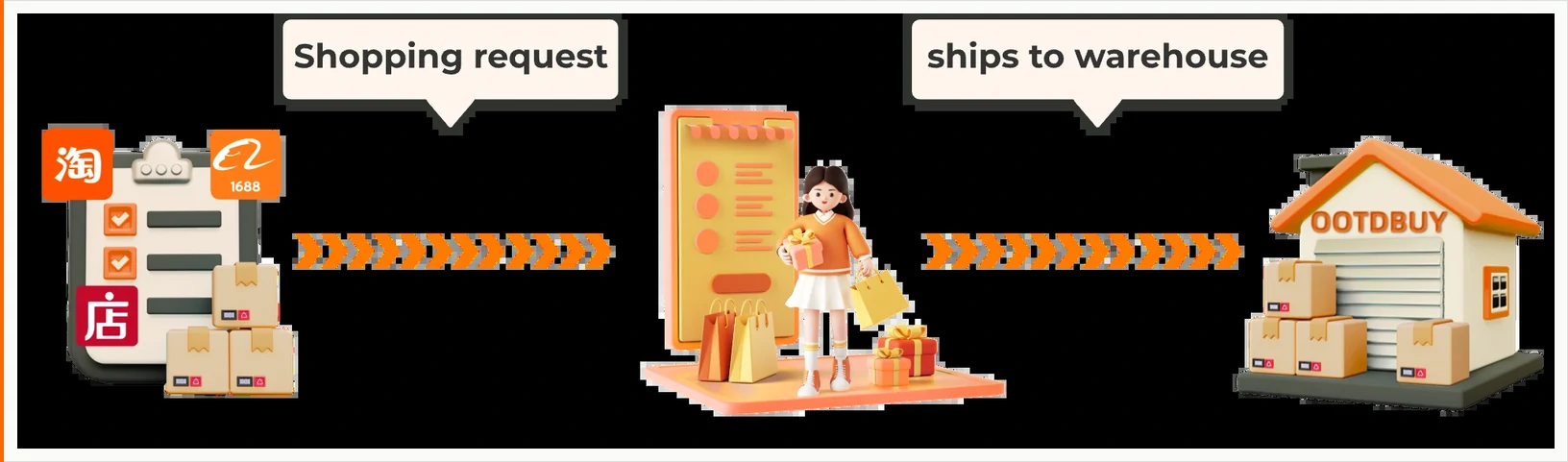
The first half of the journey is drawn by the operator itself, and the drawing is accurate in a way the words around it are not. A request goes in. A buyer acts on it. The goods ship to a building.
That building is the delivery address on the seller's order. It is the reason every promise a seller makes about delivery is measured to a warehouse in China rather than to you, and the reason a marketplace return window starts there.
The operator's written guide says a buyer contacts the seller and places the order on your behalf, and that questions at this stage go through the order inquiry rather than to the seller directly. You are not a party to that conversation, which is worth knowing before you need to be.
Guide outline
- 01Seller listingChoose a marketplace item
- 02Buying agentPlace the shopping request
- 03WarehouseReceive and store the goods
View the operator’s illustrated reference
Operator reference · dated capture
Inspection
What checking covers, and the sentence that decides most arguments
Every parcel gets opened. The operator says so in plain terms, and the first reason is not quality at all: it is a prohibited-items check, after which the goods are weighed and stored. A quality check happens as well, and it is narrower than the word suggests.
Color difference, size error, and usage effect are not within the scope of inspection
The same notice also says the warehouse will verify the quantity, colour, size and other specifications. Those two statements sit on one page and look like a contradiction. Read this site's way, they are not: the check is that the item matches what was ordered, not that the shade suits you or the size fits. That reading is this site's, and it is worth testing against your own case before you rely on it.
Three other limits are stated outright. Electrical and digital goods are checked for damage but not for quality, model or accessories. Sealed discs, handmade goods and adult products are not opened at all, so only the outside can be reported on. And the original courier box is removed: the operator repacks into its own sealed bags, which is the first moment packaging stops being the seller's problem.
Which leaves the practical question: how to check the QC photographs when they appear. The published scope answers it. Count what is in the frame against what you ordered, because quantity is verified and is the thing a photograph settles outright. Read the labels, the logos and the stitching, because a photograph settles those too. Do not try to judge shade from them, since colour difference is outside the scope and your screen is not colour managed against a warehouse light. Do not read fit into them either, unless a tape measure is in the picture. If the item is electrical, the photographs can only show that it is undamaged, not that it works, is the right model or has its accessories. And if it is sealed, handmade or an adult product, the outside of the packet is the only thing anybody looked at.
Nothing announces the photographs. They sit folded under the item on the warehouse list, and the storage clock and the return window are both already counting while you have not looked.
Six columns about one T-shirt, and two of them are next month's bill
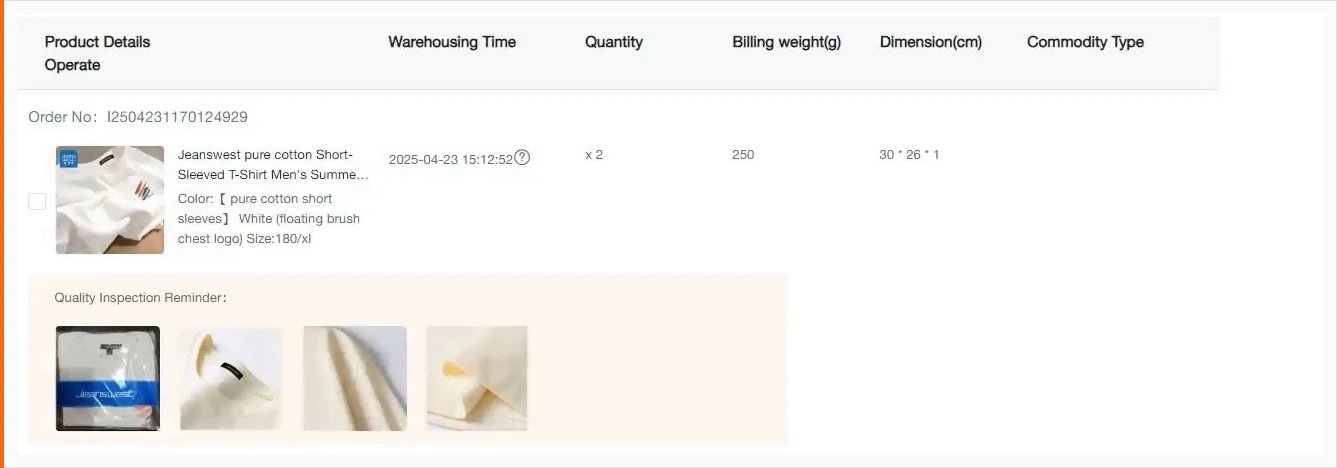
This is what the shelf actually knows about an item. A warehousing timestamp to the second, a quantity, a billing weight in grams, three dimensions in centimetres, and a commodity type that decides which carriers will take it.
The weight and the dimensions are the interesting pair, because they are not describing the past. They are the inputs to a quote that has not been given yet. Everything about the international leg is computed from numbers recorded here, by somebody else, before you were asked anything.
Underneath the row sit the inspection photographs, folded into a reminder panel rather than sent to you. Nothing notifies you when they appear. Going and looking is a habit worth forming while the return window is still open, because that is the only stretch where the photographs can still change anything.
Operator reference · dated capture
The clocks
Guide outline
- 01Normal packageThe storage period shown in the notice
- 02Unmatched packageA shorter period, without a matching account reminder
View the operator’s illustrated reference
Operator reference · dated capture
Two storage clocks, and only one of them will warn you
Free storage is the headline number, and it is real. The second clock is the one worth knowing, because it is shorter, it applies to exactly the situation where you are least likely to be paying attention, and the operator says up front that it cannot remind you about it.
The clock everybody knows
Ninety days of free storage, counted from the point the order status reads received. The operator says an email goes out when a package is close to the end of it.
The clock almost nobody quotes
Thirty days for a package the warehouse signed for but could not match to an order or to a user. The operator states the consequence in the same breath: for these, reminders cannot be given, because there is nobody to remind.
What running out means
A package left past its period is treated as given up. The operator adds a sentence that is easy to read past: once goods have been destroyed, there is no further prompt or notification.
What the clock does not measure
Shelf life. The operator gives perishables as its own example and says their expiry sits outside the storage period entirely. Ninety days of storage is not ninety days of the food staying food.
Five switches on the submission screen, and one row on a different page
When you submit a parcel, the screen offers to take things off before it is packed: the original packaging, all the tags, the hang tag, a dismantling test, and opening the package outright. The reason people reach for them is freight. Boxes are volume and volume is money.
Here is the part that is not on that screen. The operator's own returns notice lists products whose packaging, tags or accessories were removed at the user's request among the things it cannot return. It also sets separate conditions for particular goods: new trainers with the anti-theft clasp still attached, sealed cosmetics still sealed, boxed models with their tape and plastic intact.
Nobody is hiding anything. The two pages simply never appear on the same screen, and the switches are on the one you meet under time pressure. If the return window on any item in that parcel is still open, flipping a switch is the act that closes it. That connection is this site's, drawn between two operator pages: the returns notice and the submission screen itself. Where that leaves the ladder.
Operator reference · dated capture

What people ask once their first parcel is sitting on the shelf
What leaves the country, and what the carrier will not take, is the next page. What can still be undone at each stage is the ladder.
Does the warehouse photograph everything?
The operator says it inspects goods and photographs them for your review, and the photographs are attached to the item row rather than sent to you. What they are for is narrower than it looks. They record the state the item was in when it arrived, which is the thing any later argument gets judged against.
Can I keep things there indefinitely if I keep adding?
No, because the clock belongs to the package and not to the account. Each one is counted from the moment its own status reads received, so the oldest thing on the shelf is what decides when the batch has to leave. Adding a new item does not reset anything.
Why is the billing weight larger than the thing weighs?
Because it is billed, not weighed alone. The row records a weight in grams and three dimensions in centimetres, and carriers charge on whichever of the two works out larger. A light bulky coat is a volume problem dressed as a weight problem. What that does to the quote.