
Every stage undoes something smaller than the stage before it
The rules for cancelling, returning and settling are real and they are published. They are also split across four separate notices, and no one of them answers the only question anybody asks: is it too late.
Every window and condition below is quoted from a dated operator notice and linked to it. Arranging them as a ladder is this site.
The tick
You agree to the return policy before the thing you might return exists
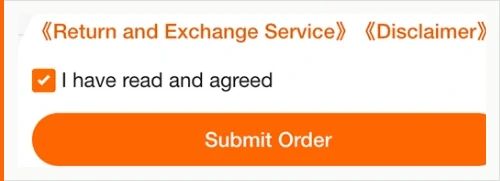
Two documents, one checkbox and one orange button. The return and exchange terms and the disclaimer are both accepted at the moment the order is submitted, which is before a buyer has contacted the seller and long before anything has been weighed.
There is nothing unusual about that, and it is still the reason these rules feel like a surprise months later. They were agreed to at the least curious moment in the whole process, with a payment screen waiting on the other side of the button.
The useful move is to read them at a different moment. Both are published as standing notices in the help centre, so the return and exchange terms can be read in full on an ordinary afternoon rather than in the two seconds before a payment.
Operator reference · dated capture
Eight stages, and what each one leaves you
Find the stage your order has actually reached, then read across from it. What is still available at that stage comes next, and after that sits the part people forget: at most stages the decision is not yours and not the operator's either.
Choose the current status shown in your OOTDBuy account. This summary follows the dated source table below.
Who decides:
| Where the order has reached | What can still be undone | Who decides |
|---|---|---|
| Submitted, nothing paid | All of it. Nothing has been bought and nobody has been instructed | You, on your own |
| Paid, the buyer has not ordered yet | The purchase, at no charge. The operator says a request made while the status is still not shipped is not charged for | The operator, and the hour matters |
| The seller has dispatched | Nothing from your side. The goods are moving towards a building you have no standing with | Nobody |
| Stocked in, inside five days | A return or an exchange, if the seller offered guaranteed returns and the item is still in re-salable condition | The seller, asked on your behalf |
| Stocked in, past five days | Storage and shipping. The operator counts the window as one hundred and twenty hours from the hour after the status changed | The clock |
| Packaging switches used at submission | Nothing, for that item. Goods whose packaging, tags or accessories were removed at the user request are listed as not returnable | A choice already made |
| Parcel submitted, freight prepaid | Nothing about the goods. The money still settles in both directions once the parcel is weighed | The scale |
| Delivered and signed for normally | Feedback, inside seventy-two hours. The operator says a normal sign-off marks the end of the process | The clock again |
Stages are grouped by this site; every window, condition and wording in them is the operator, from Returns and Refunds and Notices of the parcel receiving, both read on 2026-09-23.
The operator can ask. It cannot decide.
This is the sentence that explains why return windows behave so differently here than on a shop you buy from directly. Every return runs back through a seller who never agreed to anything with you, was paid by somebody else, and is being asked a favour in a language you do not share.
We can only return/exchange the product for you when the seller agrees
The same notice splits responsibility three ways, and two entries in the customer column deserve reading before anybody relies on a window. One is deciding the shipping cost has gone over budget. The other is the seller taking the view that there is no quality problem. Both sit on the side where the cost is yours.
On charges, the notice is generous and specific in the same breath. The first return or exchange in each calendar month carries no service fee. After that the cost is both domestic legs plus a flat fee, quoted in yuan on the notice itself and deliberately not repeated here. And one line worth committing to memory: even where the seller shipped free at purchase, that original delivery is repaid when the item goes back.
There is one more thing on that page, and it is a defect rather than a rule. A paragraph about a fourteen-day cancellation right under UK consumer regulations sits alongside the five-day window described everywhere else, with a stray page number printed in the middle of it. The operational instructions on the same page describe the five-day route. Anyone planning to rely on the longer one should ask support in writing first.
Settlement
The one reversal the system performs without being asked
Freight is the exception to everything above. When the carrier approves a weight and a volume lower than the estimate the deposit was built on, the difference comes back. No request, no window, no seller, no evidence.
It is worth naming because it is the only movement of money towards you that happens by default anywhere in this process. Every other reversal on this page requires somebody to agree to something. This one requires a set of scales.
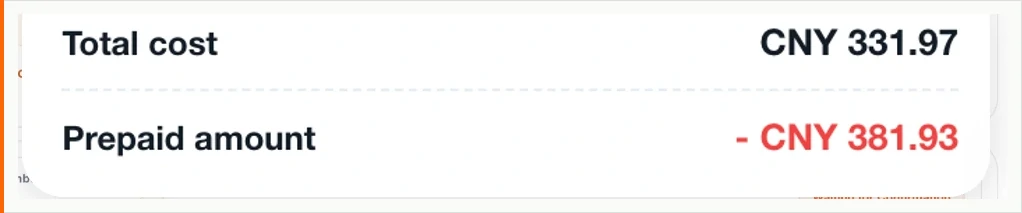
The screen states it as a subtraction rather than as good news. A total on one line, the amount already paid on the next, and no wording anywhere to indicate which of the two is larger.
Operator reference · dated capture
Operator reference · dated capture

What that screen looks like when the answer comes out below zero
Four lines, read in the order the screen sets them out. The last one is the only one that matters, and it is the one most likely to be misread, because a figure labelled payment is not usually something owed to you.
A discount line
Whatever reduced the total has already been taken off it. This line is a record of that, not something still to be applied.
A prepaid line
The deposit paid earlier, shown as a deduction rather than as a credit sitting somewhere. It is the largest figure on most of these screens.
A final payment line
The total with both deductions taken off it. On the settlement screens the operator publishes, the result comes out below zero.
Which makes it a refund wearing a payment label
A negative final payment is money owed back. The operator says the excess returns to your account, and the arithmetic on its own example screens agrees with it: the prepaid figure is the larger of the two.
The three questions that arrive in the wrong order
What the seller promised in the first place is what a link carries. What the warehouse recorded while it had the item is the warehouse page.
I changed my mind an hour after paying. Am I charged?
The operator says no, as long as the order has not shipped. Its returns notice sets three conditions that must all hold before a charge applies: no quality issue, the item already stocked in, and the free allowance for that calendar month already used. An unshipped order fails the second one, so there is nothing for a charge to attach to. Speed is the entire strategy here.
The seller says nothing is wrong with it. Now what?
Then the operator's own responsibility table puts the cost on you. That exact situation is listed among the customer-side reasons, which is a blunt way of admitting the disagreement was expected. What changes the conversation is evidence recorded before anyone disagreed, and that is what the warehouse photographs are.
Is there a window after the parcel arrives?
Two, and they do not agree. One notice asks for the original packaging and photographic evidence within two working days when a damaged parcel was signed for without being checked. The same notice asks for any problem to reach customer service within seventy-two hours, and also says a normal sign-off ends the process. The only safe reading is to treat the shortest of them as the deadline and open the box on the day it arrives.